10 Best CRMs for Outlook + Integration Features

Learn what features to expect & how each CRM stacks up
If you’re using Outlook, then you’re in luck. It allows for some great integrations with your CRM. 💪
Quick answer: Salesflare is my top pick for small and medium-sized B2B teams that want less CRM admin, with automatic contact and activity capture and a full CRM inside Outlook. Choose HubSpot for a connected sales, marketing and service suite, folk for a lightweight relationship CRM that automatically syncs Microsoft 365 activity, eWay-CRM for a workflow centered on Outlook for Windows, or ActiveCampaign when complex marketing automation is the priority.
The table below helps you choose by sales workflow. Then I explain the ten-feature Outlook checklist and compare all ten products using hands-on tests, G2 reviews and mobile app ratings.
Here we go! 👇
Which Outlook CRM should you choose?
| CRM | Best for | How it works with Outlook | Main trade-off |
|---|---|---|---|
| Salesflare | Small and medium-sized B2B teams that want less CRM admin | Full CRM in Outlook, with automatic contact creation, email/calendar capture and signature enrichment | Built for B2B relationship sales; less suited to high-volume, transactional B2C sales |
| HubSpot | Teams combining sales, marketing and service | Outlook sidebar for CRM records and activity logging | Advanced sales features require a higher-priced plan and onboarding fee |
| folk | Relationship-driven teams that want Microsoft 365 activity captured in a lightweight CRM | Real-time Outlook email, calendar and contact sync into folk | No full CRM sidebar inside Outlook; deeper outreach happens in folk |
| Freshsales | Teams prioritizing a broad sales feature set | Outlook add-in for records and activities, plus email/calendar sync | Contact lookup can require manual searches; less automatic contact upkeep |
| eWay-CRM | Teams centered on Outlook for Windows | CRM built around Outlook, with email history, contacts, deals and tasks | Full Desktop functionality requires Outlook on Windows; new contacts still need conversion |
| ActiveCampaign | Teams prioritizing complex marketing automation | Outlook contact access connected to marketing and CRM workflows | More setup and complexity; not all client emails are logged automatically |
| Microsoft Dynamics 365 Sales | Microsoft 365 teams with complex sales processes | Dynamics pane, record tracking and Exchange sync | Administrator-led setup and more manual record upkeep |
| Pipedrive | Teams prioritizing a simple visual sales pipeline | Microsoft 365 email/calendar sync; third-party add-in for inbox access | No native Outlook add-in; an external add-in adds cost |
| Zoho CRM | Budget-conscious teams needing basic Outlook CRM access | Outlook add-in and email/calendar sync | More manual contact upkeep and limited Outlook automation |
| Salesforce | Teams with complex processes and resources for customization | Outlook access to CRM records within a broader configurable platform | Setup, training and administration take more effort |
Outlook sync is not the same as automatic CRM upkeep. Check whether the CRM only copies emails and meetings, or also creates contacts, enriches their details and keeps relationship history up to date. Check your version of Outlook too: a Windows desktop integration may differ from the Mac or web experience.
What is an Outlook CRM?
An Outlook CRM is a customer relationship management system integrated directly within Microsoft Outlook. It seamlessly connects your emails, calendar events, and contacts, allowing you to manage customer relationships efficiently without leaving your inbox. By blending CRM capabilities with Outlook, you streamline workflows, enhance productivity, and maintain a clear overview of your sales activities.
When do you use it? Anytime you’re working from Outlook and want immediate access to CRM data. The benefits? Improved organization, faster response times, and effortless tracking of your sales interactions—all within a familiar interface.
Core features of an Outlook CRM
Here are 10 core features you can expect from a CRM that is well integrated with Outlook and Microsoft 365:
- Update and use your CRM from within your Outlook inbox
- Live sync your Outlook emails & Microsoft 365 calendar meetings to the CRM
- Auto-create contacts for people you’re emailing or meeting with
- Automatically enrich your contact database by syncing your contacts’ email signatures
- Send automated, personalized email sequences from your Outlook inbox
- Use (shared or private) email templates when sending emails through the CRM
- See who your colleagues know and how well, with “relationship strength scores” based on their email traffic
- Track whether people open your emails and click on the links in your emails sent from Outlook
- See whether these people who clicked email links also visit your website, which pages and for how long
- Be reminded of emails you haven’t replied to or customer conversations that have gone quiet
That’s a lot of useful stuff to follow up your leads better and boost your productivity 😄 I’ve detailed below which of these features come with each CRM.
Ranking Outlook integrated CRMs: our methodology
If you’re looking for a CRM that integrates well with your Outlook and Microsoft 365 environment, the above set of features can significantly boost your productivity.
To compile this ranking, I went through a list of around 800 possible CRMs to make a pre-selection. Then I tested every one of the 10 Outlook CRMs below first-hand and researched which of them offer which features, then detailed this for you below.
It is of course important to keep the bigger picture in mind as well when comparing CRMs, because you need to make sure your team will actually use that CRM as well. Getting a CRM that nobody uses is pretty useless 😏
Because of that, I included the current scoring for each CRM on G2.com so you get a better idea of how each CRM stacks up. It’s broken down as follows:
- Ease of Use
- Ease of Setup
- Meets Requirements
- Quality of Support
- Ease of Doing Business With
- Ease of Admin
And to top it off, I also incorporated the review score each CRM’s mobile app gets on Google Play. That way the CRM isn’t only great for Outlook, but handy on the phone too! ⭐⭐⭐⭐⭐
I then took the average of the Outlook feature score, the average G2 review score, and the Google Play score for the mobile app, to calculate… the final score! 🥇
The 10 best CRMs for Outlook ranked
Don’t want to read the whole comparison? 🤓
The top 10 best CRMs for Outlook in 2026 are:
- Salesflare: 9.7/10 🏆
- HubSpot CRM & Sales Hub: 8.2/10
- folk: 7.3/10
- Freshsales by Freshworks: 7.1/10
- eWay-CRM: 7.1/10
- ActiveCampaign: 7.0/10
- Microsoft Dynamics 365 Sales: 6.8/10
- Pipedrive: 6.2/10
- Zoho CRM: 6.2/10
- Salesforce Sales Cloud: 6.1/10
Want to dig into the details? Read on!
1. Salesflare [9.7/10]
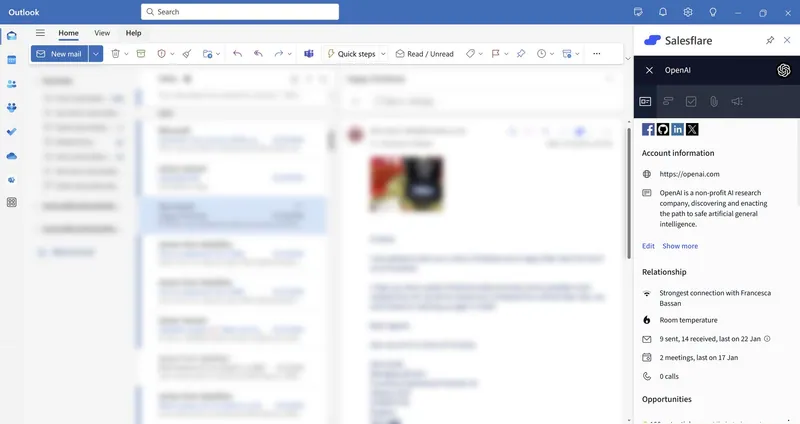
Best for: Small and medium-sized B2B sales teams that want less CRM admin. Salesflare captures Outlook emails, Microsoft 365 meetings and contact information automatically, enriches records from email signatures, and brings that context into your inbox to help you follow up. Automatic data capture is also the foundation of Salesflare’s broader approach to intelligent sales automation and AI.
Main trade-off: Built for B2B relationship sales; less suited to high-volume, transactional B2C sales.
Salesflare (founded in 2014) is used by thousands of small and medium-sized businesses who sell to other businesses (incl. agencies, consultancies, development houses, tech companies, …). It’s top ranked across review platforms and is the #1 CRM on Product Hunt, the leading community for product enthusiasts.
Salesflare’s Outlook plugin doesn’t only offer a really tight integration (more on that below). What’s absolutely unique about it is that it brings 100% of the CRM functionality into Outlook, so you never need to switch between Outlook and your browser while selling (although if you want to use Salesflare in the browser and do all the same things from there, that is fully possible too 👊).
Many CRMs are strongly focused on integrating with Google Workspace / Gmail. Salesflare offers virtually the exact same integration in Outlook as well, making it a strong fit for small and medium-sized B2B sales teams using Outlook/Microsoft 365 that want less CRM admin through automatic data capture.
“What I like best about Salesflare is the integration with LinkedIn and with Microsoft Outlook/365. Simply amazing in how in a few weeks it has simplified my tasks and integration in managing contacts and relationships.” writes Michael R., CEO of a market research company, about Salesflare’s Outlook integration.
Testing it out
When you test Salesflare, the integration with Outlook is immediately noticeable. You can access all CRM features directly from your inbox, making managing leads and contacts incredibly convenient. The automated data entry feature is particularly impressive; as soon as you sync your email, Salesflare begins auto-populating customer profiles with relevant data, including contact details and social media information.
The email tracking capabilities stand out as well. Every email you send is tracked, showing you when it is opened and which links are clicked. This level of insight helps you understand how engaged your prospects are, making planning follow-ups much more strategic. Additionally, meeting scheduling and logging are seamless, with all your appointments automatically synced and detailed notes added to each record. This ensures you are always prepared for your interactions.
Scoring
Without further ado, here’s an analysis of how Salesflare stacks up:
Features Salesflare offers: 10/10
- Update and use your CRM from within your Outlook inbox
- Live sync your Outlook emails & Microsoft 365 calendar meetings to the CRM
- Auto-create contacts for people you’re emailing or meeting with
- Automatically enrich your contact database by syncing your contacts’ email signatures
- Send automated, personalized email sequences from your Outlook inbox
- Use (shared or private) email templates when sending emails through the CRM
- See who your colleagues know and how well, with “relationship strength scores” based on their email traffic
- Track whether people open your emails and click on the links in your emails sent from Outlook
- See whether these people who clicked email links also visit your website, which pages and for how long
- Be reminded of emails you haven’t replied to or customer conversations that have gone quiet
Features Salesflare doesn’t offer: none
Pros:
- Integrates with LinkedIn too
- Available for Windows, Mac and on the Web
- 100% accessible within Outlook
Cons:
- Signing up is only possible with business email
G2 review scoring:
- Ease of Use: 9.3
- Ease of Setup: 9.4
- Meets Requirements: 9.1
- Quality of Support: 9.7
- Ease of Doing Business With: 9.8
- Ease of Admin: 9.3
Final result
- Outlook CRM feature score: 10/10
- Average G2 review score: 9.4/10
- Google Play review score: 4.8/5 → 9.6/10
- FINAL SCORE: 9.7/10
Pricing
Pricing to get all of the above (10 of 10 features) on the Salesflare Pro plan:
$49/user/month (billed annually)
$64/user/month (billed monthly)
Salesflare offers a free trial of up to 30 days.
Try Salesflare
Want to see it all in action? You can try Salesflare for free. 👈
It only takes a few minutes to start a trial and install the Outlook plugin (you can find it in Settings > Applications & Integrations).
Try it with Outlook to see how your emails and meetings can keep your customer records up to date.

2. HubSpot CRM & Sales Hub [8.2/10]
Best for: Teams that want sales, marketing and customer service in one connected suite.
Main trade-off: The advanced sales features tested here require a higher-priced Sales Hub plan and an onboarding fee. The review also found gaps in automatic email logging.
HubSpot is a marketing automation platform turned everything platform. It was founded in 2006 to make marketing automation easier.
Nowadays, HubSpot’s main selling point is offering an all-in-one solution, including marketing, sales, service and operations. If you don’t like using different apps and integrating them (using tools like Zapier and native integrations), then HubSpot might be what you’re looking for.
To get CRM functionality that is comparable to what you’re getting with the other CRMs in this ranking, you need to get two HubSpot products: its CRM and its Sales Hub.
In terms of Outlook / Microsoft 365 integration, HubSpot does a fair job. Stefano C., CRM Operations Manager of a marketing agency, writes in his review: “On the sales side, the Outlook add-in allows us to make sure all sales activity by all team members is being tracked and logged in the CRM, so we are able to track performance and customer interactions quickly and easily.”
However, the pricing to get all this handy functionality (7 features) is quite steep, starting at $90-100/seat/month plus an extra required fee of $1500 for onboarding.
Testing it out
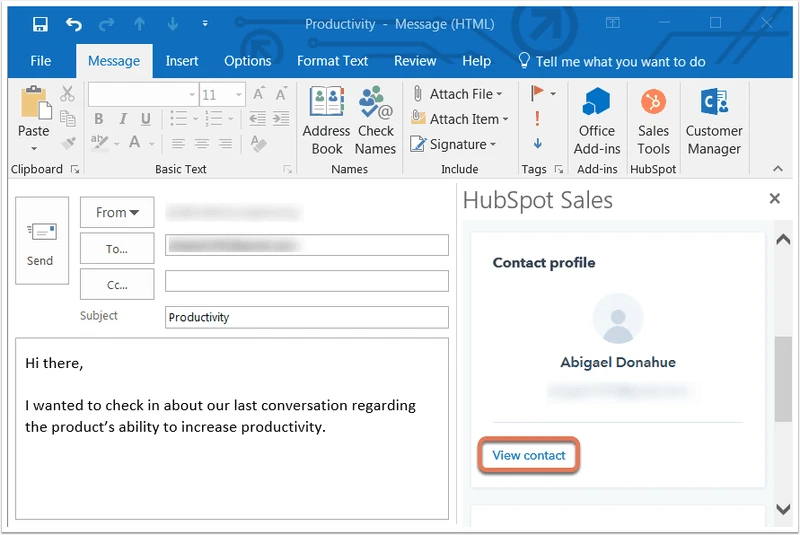
Testing HubSpot CRM & Sales Hub was a smooth experience, particularly because of its robust Outlook integration. The sidebar in Outlook provided instant access to contact details, recent activities, and deals, allowing me to update records and log interactions without leaving my inbox.
The setup was straightforward, and the system did a good job of syncing my calendar and emails. However, I noticed that not all emails were synced, which required occasional manual updates. Despite this, the overall functionality and integration with other HubSpot tools provided a comprehensive solution for managing marketing, sales, and customer service activities in one place.
Scoring
Features HubSpot CRM & Sales Hub offers: 7/10
- Update and use your CRM from within your Outlook inbox
- Live sync your Outlook emails & Microsoft 365 calendar meetings to the CRM
- Automatically enrich your contact database by syncing your contacts’ email signatures
- Send automated, personalized email sequences from your Outlook inbox
- Use (shared or private) email templates when sending emails through the CRM
- Track whether people open your emails and click on the links in your emails sent from Outlook
- See whether these people who clicked email links also visit your website, which pages and for how long
Features HubSpot CRM & Sales Hub doesn’t offer:
- Auto-create contacts for people you’re emailing or meeting with
- See who your colleagues know and how well, with “relationship strength scores” based on their email traffic
- Be reminded of emails you haven’t replied to or customer conversations that have gone quiet
Pros:
- All-in-one business platform
- Outlook sidebar is integrated everywhere
Cons:
- Expensive pricing
- Doesn’t sync all emails
G2 review scoring:
- Ease of Use: 8.7
- Ease of Setup: 8.3
- Meets Requirements: 8.6
- Quality of Support: 8.6
- Ease of Doing Business With: 8.7
- Ease of Admin: 8.6
Final result
- Outlook CRM feature score: 7/10
- Average G2 review score: 8.6/10
- Google Play review score: 4.5/5 → 9.0/10
- FINAL SCORE: 8.2/10
Pricing
Pricing to get all of the above (7 of 10 features)on the HubSpot Sales Hub Professional plan:
$90/seat/month (billed annually)
$100/seat/month (billed monthly)
+ an extra required fee of $1500 for onboarding
HubSpot offers a free trial of 14 days.
3. folk [7.3/10]
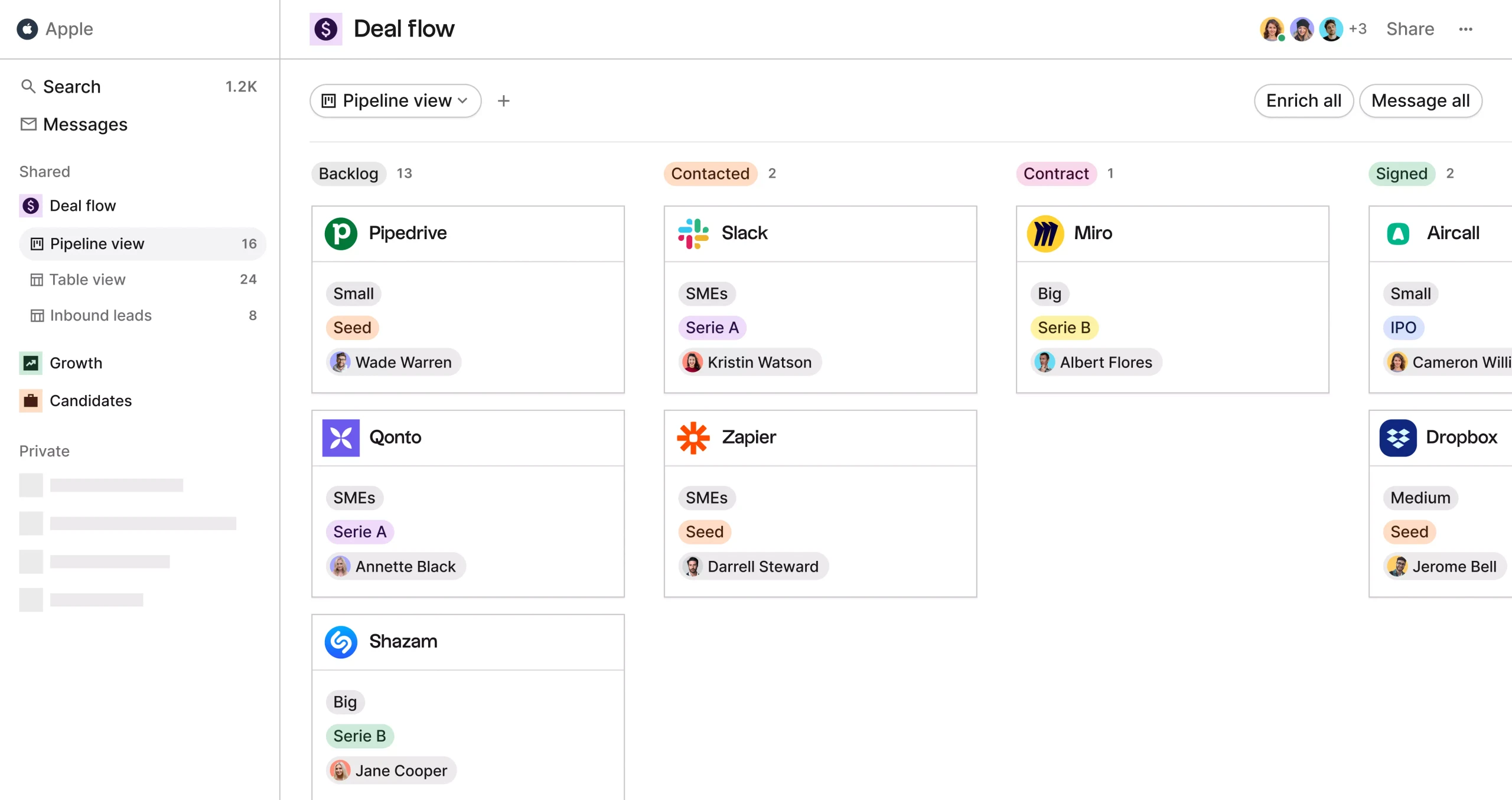
Best for: Relationship-driven teams that want their Outlook and Microsoft 365 activity automatically captured in a lightweight CRM.
Main trade-off: folk syncs Microsoft contacts, emails and calendar activity into the CRM, but it does not put the full CRM inside Outlook. Deeper outreach and email tracking happen in folk itself.
folk is a lightweight CRM focused on relationship management, prospecting and keeping track of people without the complexity of a traditional enterprise CRM.
Its Microsoft 365 integration works mainly in the background. After connecting your Microsoft account, folk imports your contacts and interactions from Outlook and keeps new email and calendar activity synced. This makes it useful if you want your CRM history to build itself while you keep communicating through Outlook.
Where folk stands out more is relationship intelligence. It can show who on your team has the strongest relationship with a contact, and its Follow-up Assistant can surface conversations that have gone quiet and suggest who to follow up with.
The flip side is that Outlook itself is not where you run the CRM. Unlike the most deeply integrated Outlook CRMs in this ranking, there is no full CRM sidebar for managing records and deals directly from your inbox. folk also has its own email outreach and tracking functionality, but those features live in folk rather than being part of the Outlook workflow.
Testing it out
When I tested folk with a Microsoft account, connecting it was straightforward. Contacts, emails and calendar interactions started flowing into the CRM, and I liked how the resulting interaction history kept the context around each relationship together without requiring much manual logging.
I particularly liked the relationship intelligence and follow-up functionality. Being able to see the strongest connection to someone and surface conversations that had gone quiet fits folk’s relationship-first approach well.
The limitation became clear when I went back to Outlook. I still had to switch to folk for the actual CRM work and deeper outreach. That makes its Microsoft integration good for automatic capture and relationship context, but less complete for teams that specifically want to run their sales workflow from inside Outlook.
Scoring
Features folk offers: 5/10
- Live sync your Outlook emails and Microsoft 365 calendar meetings to the CRM
- Auto-create contacts for people you’re emailing or meeting with
- Use email templates when sending emails through the CRM
- See who your colleagues know and how well, with relationship strength based on shared interactions
- Be reminded of conversations that have gone quiet
Features folk doesn’t offer:
- Update and use your full CRM from within your Outlook inbox
- Automatically enrich your contact database from email signatures
- Send automated, personalized email sequences from Outlook
- Track opens and clicks for emails sent directly from Outlook
- Track website visits from people who clicked email links
Pros:
- Microsoft emails, calendar meetings and contacts sync automatically
- Strong relationship intelligence and proactive follow-up functionality
Cons:
- No full CRM interface inside Outlook
- Deeper email outreach and tracking happens in folk itself
G2 review scoring:
- Ease of Use: 9.0
- Ease of Setup: 8.9
- Meets Requirements: 8.4
- Quality of Support: 9.1
- Ease of Doing Business With: 8.9
- Ease of Admin: 8.7
Final result
- Outlook CRM feature score: 5/10
- Average G2 review score: 8.8/10
- Google Play review score: no rating available yet, so an average substitute is used: 8.2/10
- FINAL SCORE: 7.3/10
Pricing
Pricing to get all of the above on the folk Standard plan:
- $24/member/month (billed annually)
- $30/member/month (billed monthly)
folk offers a free trial of 14 days.
4. Freshsales by Freshworks [7.1/10]
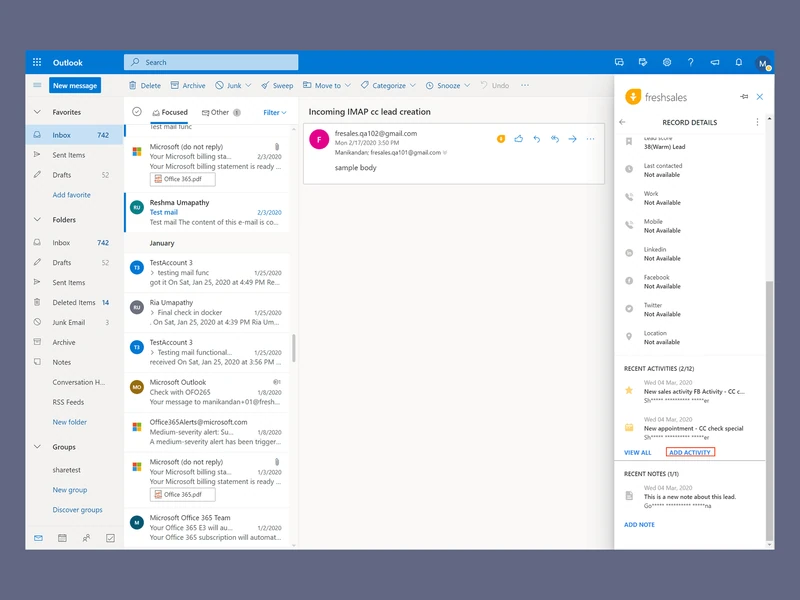
Best for: Teams that want a broad sales feature set with access to records and activities from Outlook.
Main trade-off: Contact lookup can require manual searches, and the integration does less automatic contact upkeep than the strongest options here.
Freshsales by Freshworks is a sales CRM from Freshworks, the company behind / initially called Freshdesk. Freshworks was founded in 2010 to provide a better, cheaper solution for customer service teams.
Freshworks’ main selling point is its feature depth. It has also managed to offer this range of functionality through an easier to use interface than its competitor/predecessor from the same city, Zoho.
While its Outlook integration is not as deep as with better performing CRMs in this ranking, it still deserves a mention in this ranking due to its relatively popular Outlook add-on.
Testing it out
Using Freshsales by Freshworks with Outlook was a pleasant experience, thanks to its user-friendly interface and straightforward integration process. The CRM allowed me to update records and manage deals directly from my inbox, which was highly efficient. Syncing emails and calendar meetings worked well, ensuring that all my interactions were logged without much effort.
One feature I appreciated was the email templates, which made it easy to send consistent messages to prospects. However, finding related contacts sometimes required manual searches, and the installation process was slightly complex compared to other CRMs. Overall, Freshsales by Freshworks provided a solid integration that streamlined many of my daily tasks.
Scoring
Features Freshsales by Freshworks offers: 4/10
- Update and use your CRM from within your Outlook inbox
- Live sync your Outlook emails & Microsoft 365 calendar meetings to the CRM
- Send automated, personalized email sequences from your Outlook inbox
- Use (shared or private) email templates when sending emails through the CRM
Features Freshsales by Freshworks doesn’t offer:
- Auto-create contacts for people you’re emailing or meeting with
- Automatically enrich your contact database by syncing your contacts’ email signatures
- See who your colleagues know and how well, with “relationship strength scores” based on their email traffic
- Track whether people open your emails and click on the links in your emails sent from Outlook
- See whether these people who clicked email links also visit your website, which pages and for how long
- Be reminded of emails you haven’t replied to or customer conversations that have gone quiet
Pros:
- Add-in available for Windows, Mac and on the Web
- Possibility to add leads, activities, … from Outlook
Cons:
- Finding a related contact may need a manual search
- Installation process was a little complex in our testing
G2 review scoring:
- Ease of Use: 9.0
- Ease of Setup: 8.7
- Meets Requirements: 8.7
- Quality of Support: 8.8
- Ease of Doing Business With: 9.0
- Ease of Admin: 8.9
Final result
- Outlook CRM feature score: 4/10
- Average G2 review score: 8.9/10
- Google Play review score: 4.2/5 → 8.4/10
- FINAL SCORE: 7.1/10
Pricing
Pricing to get all of the above (4 of 10 features) on the Freshsales Enterprise plan*:
$59/user/month (billed annually)
$71/user/month (billed monthly)
* Sequences with stricter limits also available on Pro plan
Freshsales by Freshworks offers a free trial of 21 days.
5. eWay-CRM [7.1/10]
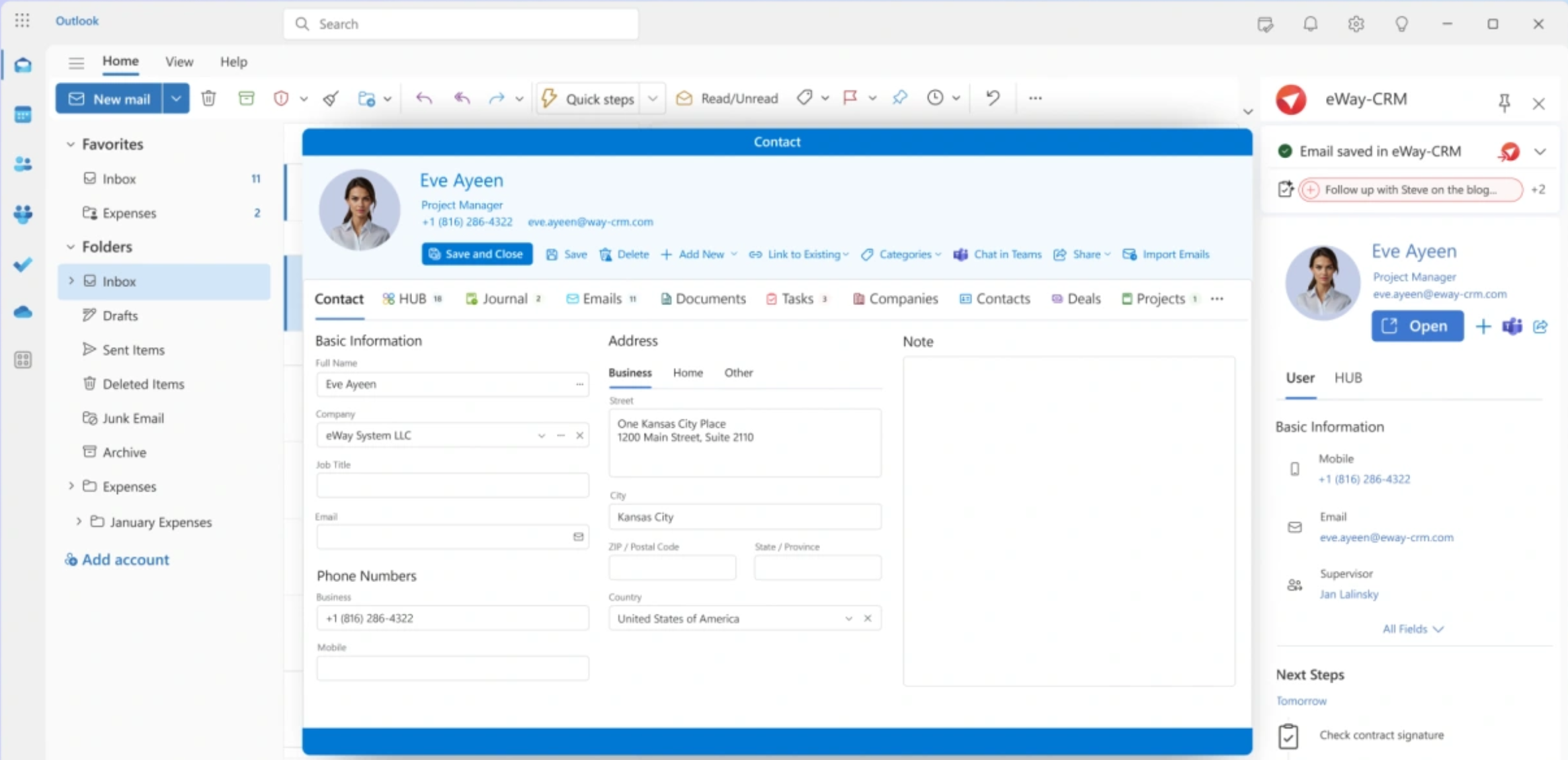
Best for: Teams that want Outlook for Windows to be their main CRM workspace, including deals, projects and tasks.
Main trade-off: Full Desktop functionality requires Outlook on Windows. Mac, web and mobile users rely on eWay-CRM Online, and new contacts still need to be converted rather than created automatically.
eWay-CRM is a CRM built specifically around Microsoft Outlook. Unlike most CRMs on this list, it lives inside Outlook and uses it as its main working environment.
It can automatically save emails, sync your Outlook calendar and contacts, recognize contact details from email signatures, and keep the complete customer history available from your inbox. It also adds deals, projects, tasks and marketing functionality around this.
On the flip side, its sales engagement functionality is less advanced. It doesn’t offer true automated email sequences from Outlook, relationship strength scores, or open and click tracking for regular one-to-one Outlook emails.
Testing it out
Using eWay-CRM with Outlook felt more like extending Outlook than integrating it with a separate CRM. Selecting an email brings up the contact and shared communication history in a side panel, and I could save emails or turn them into contacts, deals and tasks without leaving my inbox.
There are still some manual steps. New contacts are suggested or converted from emails rather than automatically created, for instance. Follow-up reminders can be handled with tasks and workflows, but eWay-CRM doesn’t automatically detect every conversation that has gone quiet.
The Outlook focus is both its biggest strength and its main limitation. Its full-featured Desktop product requires Outlook on Windows, while Mac, web and mobile users rely on eWay-CRM Online, making it a weaker fit for mixed-device teams or companies that may move away from Microsoft 365.
Scoring
Features eWay-CRM offers: 5/10
- Update and use your CRM from within your Outlook inbox
- Live sync your Outlook emails & Microsoft 365 calendar meetings to the CRM
- Automatically enrich your contact database by syncing your contacts’ email signatures
- Use (shared or private) email templates when sending emails through the CRM
- Be reminded of emails you haven’t replied to or customer conversations that have gone quiet
Features eWay-CRM doesn’t offer:
- Auto-create contacts for people you’re emailing or meeting with
- Send automated, personalized email sequences from your Outlook inbox
- See who your colleagues know and how well, with “relationship strength scores” based on their email traffic
- Track whether people open your emails and click on the links in your emails sent from Outlook
- See whether these people who clicked email links also visit your website, which pages and for how long
Pros:
- One of the deepest Outlook integrations of the CRMs in this comparison
- Deals, projects, tasks and workflows are integrated into the same environment
Cons:
- New contacts still need to be converted rather than being created automatically
- Full functionality is tied to Outlook on Windows; Mac, web and mobile users rely on eWay-CRM Online
G2 review scoring:
- Ease of Use: 8.2/10
- Ease of Setup: 9.7/10
- Meets Requirements: 8.9/10
- Quality of Support: 9.2/10
- Ease of Doing Business With: Not enough data
- Ease of Admin: Not enough data
G2 currently doesn’t publish enough data for the last two scores, so the average below is based on the four available scores.
Final result:
- Outlook CRM feature score: 5.0/10
- Average G2 review score: 9.0/10
- Google Play review score: 3.6/5 → 7.2/10
- FINAL SCORE: 7.1/10
Pricing
Pricing to get all of the above (5 features) on the eWay-CRM Contacts & Companies Standard plan:
- $24/user/month (billed annually)
- $27/user/month (billed monthly)
eWay-CRM offers a 14-day trial with all features.
6. ActiveCampaign [7.0/10]
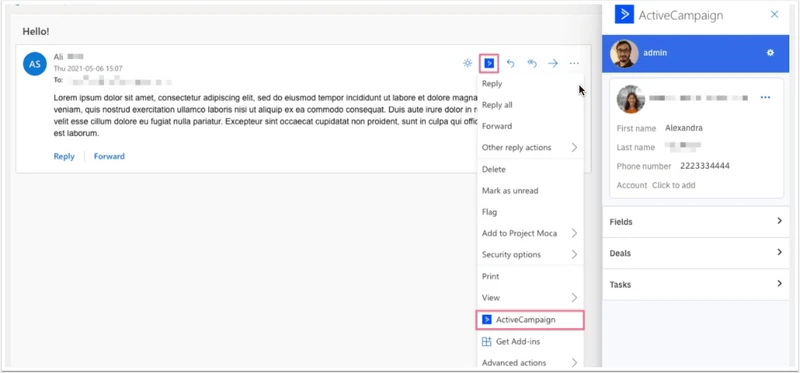
Best for: Teams that prioritize complex marketing automation, including ecommerce and high-volume B2C campaigns.
Main trade-off: Setup and workflows can become complex, and the Outlook integration does not automatically log all client communications.
ActiveCampaign is an email marketing/automation platform, founded in 2003. It now brands itself as a customer experience automation (CXA) platform, to cover its expanding range of functionality.
ActiveCampaign added a small business CRM to its offering in 2014, as a sales focused add-on to the rest of the platform. This integration between email automation and CRM is probably its main forte.
Setting up ActiveCampaign is not a light task and its software may become overwhelming, while the CRM aspect itself on the other hand will not be as feature rich compared to the other CRMs in this list.
This is reflected in its Outlook integration as well. In his review, Corey W., a freelance writer, says: “Like some other CRM systems it would be useful that with the Microsoft Outlook plug in, emails to and from the client are automatically uploaded to the customer record which ActiveCampaign doesn’t have.”
When people compare ActiveCampaign to Salesflare, which also offers automated emails and email sequences, our advice is usually simple: if you’re an ecommerce company or B2C company, or you need very complex or very high volume email automation, ActiveCampaign is probably what you’re looking for. If you’re a B2B company with an active sales team and the need to automate more personal emails, then go with Salesflare.
Testing it out
ActiveCampaign’s integration with Outlook was decent but left some room for improvement. Setting up the integration required a bit of effort, but once done, I could manage CRM activities from my inbox. The automation workflows were powerful, allowing me to create complex sequences that saved time and ensured consistent follow-ups.
However, I found that not all client communications were automatically logged, which sometimes required manual entry. The interface, while feature-rich, felt slightly overwhelming at times, especially for users primarily focused on CRM functionalities rather than extensive email marketing. Despite these challenges, the ability to track website visits and engagement from email links provided valuable insights into customer behavior.
Scoring
Features ActiveCampaign offers: 4/10
- Update and use your CRM from within your Outlook inbox
- Send automated, personalized email sequences from your Outlook inbox
- Use (shared or private) email templates when sending emails through the CRM
- See whether these people who clicked email links also visit your website, which pages and for how long
Features ActiveCampaign doesn’t offer:
- Live sync your Outlook emails & Microsoft 365 calendar meetings to the CRM
- Auto-create contacts for people you’re emailing or meeting with
- Automatically enrich your contact database by syncing your contacts’ email signatures
- See who your colleagues know and how well, with “relationship strength scores” based on their email traffic
- Track whether people open your emails and click on the links in your emails sent from Outlook
- Be reminded of emails you haven’t replied to or customer conversations that have gone quiet
Pros:
- Complex automation flows possible
- Many integrations available
Cons:
- Platform can be quite overwhelming
- Expensive to add extra contacts on Marketing plans
G2 review scoring:
- Ease of Use: 8.2
- Ease of Setup: 8.0
- Meets Requirements: 8.8
- Quality of Support: 8.5
- Ease of Doing Business With: 8.8
- Ease of Admin: 8.4
Final result
- Outlook CRM feature score: 4/10
- Average G2 review score: 8.5/10
- Google Play review score: 4.3/5 → 8.6/10
- FINAL SCORE: 7.0/10
Pricing
Pricing to get all of the above (4 of 10 features) on the ActiveCampaign Pro plan with the “Enhanced CRM” add-in that includes “Pipelines & sales engagement”:
$260/month (billed annually, with max. 2500 contacts & 6 users included)
$294/month (billed monthly with annual commitment, with max. 2500 contacts & 6 users included)
ActiveCampaign offers a free trial of 14 days.
7. Microsoft Dynamics 365 Sales [6.8/10]
Best for: Microsoft 365 teams that need a configurable sales CRM with access from Outlook.
Main trade-off: Administrator-led setup and explicit record tracking mean more upkeep than a self-maintaining CRM.
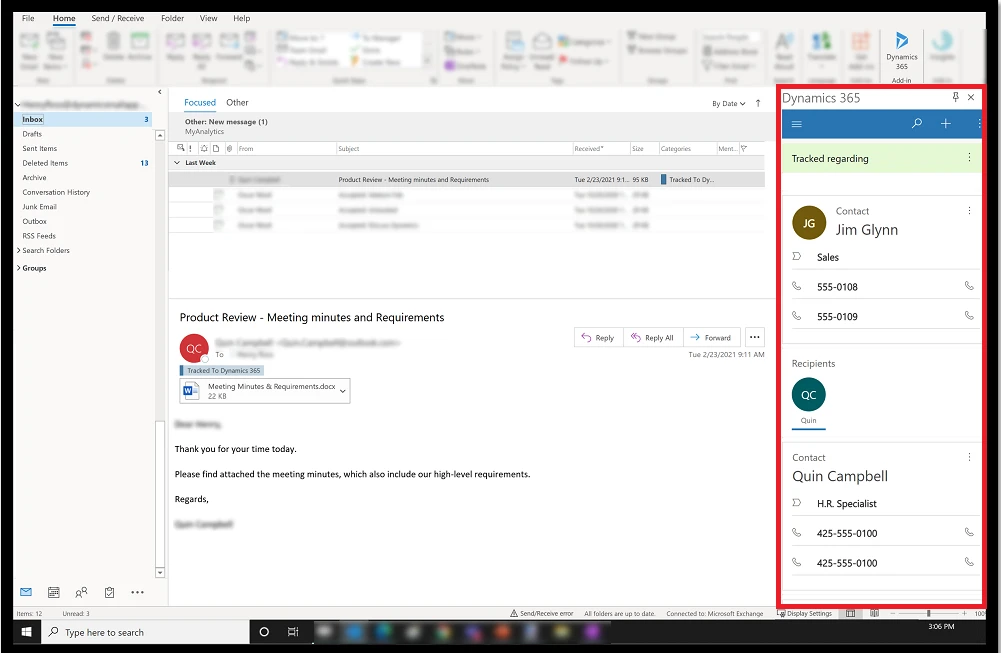
Dynamics 365 Sales is Microsoft’s own sales CRM, with accounts, contacts, leads and opportunities connected to its wider business software platform. Its Outlook integration comes through Dynamics 365 App for Outlook, available in desktop, web and mobile Outlook.
The add-in lets you look up CRM information alongside an email or appointment and associate that activity with the relevant record. That is particularly useful for companies already running Dynamics, because the inbox becomes another way to work with the same customer information.
There is more to the sales product than the Outlook pane. Sales Premium adds relationship intelligence based on Dynamics and Exchange data, while sequences and prioritized work lists live in the Dynamics Sales accelerator. The Outlook add-in connects to that broader system; it does not put every sales feature inside your inbox.
Compared with lighter Outlook CRMs, there is more for an administrator to configure, including mailboxes and server-side synchronization. It is a strong ecosystem fit for a company already committed to Dynamics, but using Outlook alone is not a reason to take on that extra setup and CRM administration.
Testing it out
Testing Dynamics 365 Sales with Outlook was a bit of a mixed experience. The integration itself is useful: I could open the Dynamics pane from Outlook, look up CRM information and link emails or appointments to the right account or opportunity without having to switch constantly between applications.
Getting there was less effortless. Dynamics relies on server-side synchronization and the mailbox and Outlook app need to be configured correctly, so installation is more of an administrator-led process than simply adding a lightweight Outlook extension. I also found the actual tracking workflow more manual than I expected, as emails and meetings often need to be explicitly associated with the relevant CRM record.
The integration makes a lot of sense for companies already running Dynamics and Microsoft 365, but it did not feel like Dynamics automatically turned Outlook into a fully self-maintaining CRM. Contact tracking has also become more limited with the move to the new Outlook.
Scoring
Features Dynamics 365 Sales offers: 5/10
- Update and use your CRM from within your Outlook inbox
- Live sync your Outlook emails & Microsoft 365 calendar meetings to the CRM
- Use (shared or private) email templates when sending emails through the CRM
- See who your colleagues know and how well, with “relationship strength scores” based on their email traffic
- Be reminded of emails you haven’t replied to or customer conversations that have gone quiet
Features Dynamics 365 Sales doesn’t offer in this comparison:
- Auto-create contacts for people you’re emailing or meeting with
- Automatically enrich your contact database by syncing your contacts’ email signatures
- Send automated, personalized email sequences from your Outlook inbox
- Track whether people open your emails and click on the links in your emails sent from Outlook
- See whether these people who clicked email links also visit your website, which pages and for how long
Dynamics 365 Sales’ G2 review scoring:
- Ease of Use: 7.5
- Ease of Setup: 7.2
- Meets Requirements: 8.1
- Quality of Support: 7.5
- Ease of Doing Business With: 7.8
- Ease of Admin: 7.6
Final result:
- Outlook CRM feature score: 5/10
- Average G2 review score: 7.6/10
- Google Play review score: 3.9/5 → 7.8/10
- FINAL SCORE: 6.8/10
Pricing
Pricing to get all of the above (5 of 10 features) on the Microsoft Dynamics 365 Sales Premium plan:
- $150/user/month (billed annually)
Dynamics 365 Sales offers a 30-day free trial.
8. Pipedrive [6.2/10]
Best for: Small sales teams that prioritize a simple visual pipeline and are comfortable doing most CRM work outside Outlook.
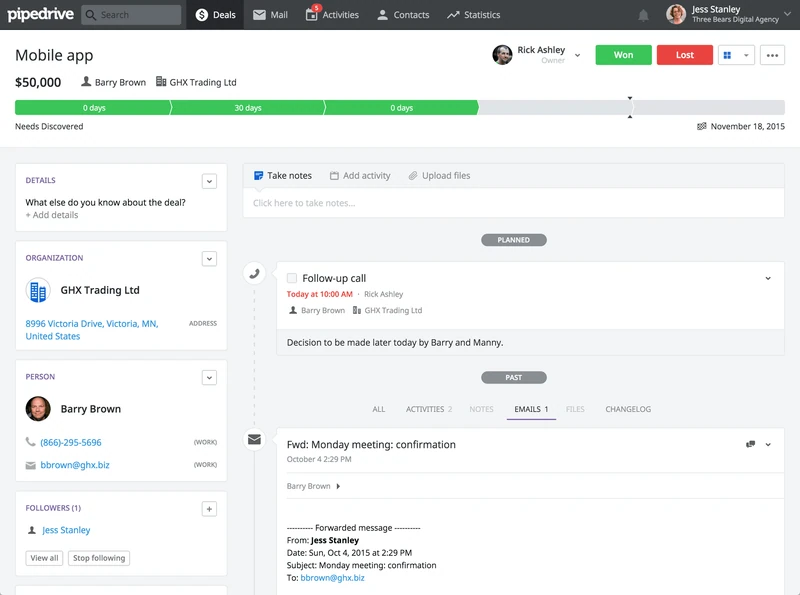
Main trade-off: Pipedrive no longer has a native Outlook add-in. Inbox access requires a third-party add-in with an additional cost.
Pipedrive is an easy-to-use and easy-to-setup sales CRM for small businesses, and is therefore compared to Salesflare very often.
The company was founded in 2010 to launch a counterreaction to enterprise CRMs like Salesforce, which are built more for enterprise needs than they are for sales teams. Pipedrive set out to change that.
While the company has been doing its best in recent years to build out closer Outlook and Microsoft 365 sync features, it still has some work to do on the inbox integration front. Its relatively low depth of integration gives it the lowest Outlook feature score in this ranking; stronger mobile app and G2 scores are what keep it off the bottom.
When it comes to an actual Outlook add-in, Pipedrive has discontinued this in 2020 already. You now need to use an external add-in like Pipelook or Saysync.
Testing it out
Retesting Pipedrive with Outlook has been a bit challenging since the native add-in doesn’t exist anymore. Instead, I had to rely on third-party solutions for integration. Once set up, the CRM allowed me to sync emails and calendar events, but the process was not as seamless as I hoped.
The email templates feature was useful, but the absence of direct integration with Outlook’s inbox for updating CRM records and auto-creating contacts was a significant drawback. Despite its user-friendly design and ease of setup, the need for external tools to achieve full functionality made Pipedrive less appealing for those looking for a tight Outlook integration.
Scoring
Features Pipedrive offers: 2/10
- Live sync your Outlook emails & Microsoft 365 calendar meetings to the CRM
- Use (shared or private) email templates when sending emails through the CRM
Features Pipedrive doesn’t offer:
- Update and use your CRM from within your Outlook inbox
- Auto-create contacts for people you’re emailing or meeting with
- Automatically enrich your contact database by syncing your contacts’ email signatures
- Send automated, personalized email sequences from your Outlook inbox
- See who your colleagues know and how well, with “relationship strength scores” based on their email traffic
- Track whether people open your emails and click on the links in your emails sent from Outlook
- See whether these people who clicked email links also visit your website, which pages and for how long
- Be reminded of emails you haven’t replied to or customer conversations that have gone quiet
Pros:
- Easy-to-use and easy-to-setup CRM
- Focused on sales and lead follow up
Cons:
- No native Outlook add-in available anymore
- Automation features not highly developed
G2 review scoring:
- Ease of Use: 8.8
- Ease of Setup: 8.7
- Meets Requirements: 8.5
- Quality of Support: 8.4
- Ease of Doing Business With: 8.7
- Ease of Admin: 8.6
Final result
- Outlook CRM feature score: 2/10
- Average G2 review score: 8.6/10
- Google Play review score: 4.0/5 → 8.0/10
- FINAL SCORE: 6.2/10
Pricing
Pricing to get all of the above (2 of 10 features) on Pipedrive Growth plan:
$39/seat/month (billed annually)
$49/seat/month (billed monthly)
+ $7-15/user/month for an external Outlook add-in
Pipedrive offers a free trial of 14 days.
9. Zoho CRM [6.2/10]
Best for: Budget-conscious teams that need basic CRM access and email/calendar sync from Outlook.
Main trade-off: Limited automatic contact upkeep means more manual entry, and the review notes usability and email-linking limitations.
Zoho is a true household name in the CRM industry, so I couldn’t omit them from this ranking.
Zoho launched its small business CRM product in 2005 and has historically been positioning itself as a cheaper alternative to Salesforce. That is immediately its main selling point.
If you’re looking for a CRM solution, Zoho has many tiers (and products even: Zoho CRM, Zoho CRM Plus, Zoho One, …). To get all three features below, you need to get on the Professional plan of its standard Zoho CRM product. Do note that its add-ons (like the comparable Gmail add-on) usually don’t get the best review ratings.
Testing it out
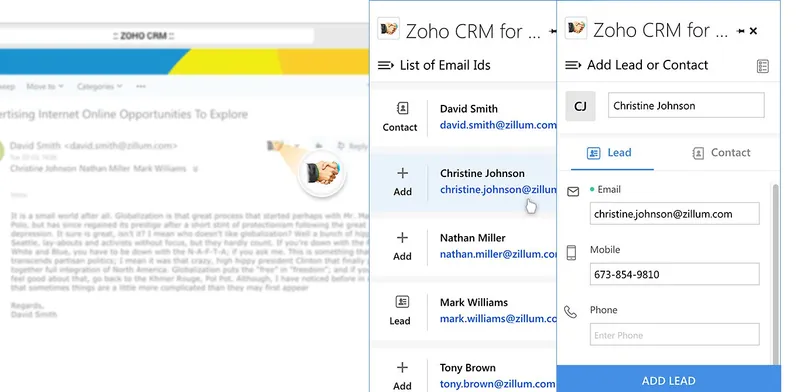
Zoho CRM’s integration with Outlook provided a cost-effective solution for managing customer relationships. The setup was relatively easy, and I could update CRM records directly from my inbox. The live sync feature worked well for emails and calendar events, ensuring that all interactions were captured.
However, I noticed that some advanced features, such as auto-creating contacts and enriching the database with email signatures, were missing. This required more manual input compared to other CRMs. Despite these limitations, Zoho CRM offered a solid, budget-friendly option for small businesses looking to integrate their CRM with Outlook.
Scoring
Features Zoho CRM offers: 3/10
- Update and use your CRM from within your Outlook inbox
- Live sync your Outlook emails & Microsoft 365 calendar meetings to the CRM
- Use (shared or private) email templates when sending emails through the CRM
Features Zoho CRM doesn’t offer:
- Auto-create contacts for people you’re emailing or meeting with
- Automatically enrich your contact database by syncing your contacts’ email signatures
- Send automated, personalized email sequences from your Outlook inbox
- See who your colleagues know and how well, with “relationship strength scores” based on their email traffic
- Track whether people open your emails and click on the links in your emails sent from Outlook
- See whether these people who clicked email links also visit your website, which pages and for how long
- Be reminded of emails you haven’t replied to or customer conversations that have gone quiet
Pros:
- The cheapest CRM option in this list
- Add-in available for Windows, Mac and on the Web
Cons:
- Not the most user friendly or prettiest software
- Reviewers & forum users complain about not being able to link emails to records
G2 review scoring:
- Ease of Use: 8.3
- Ease of Setup: 8.0
- Meets Requirements: 8.4
- Quality of Support: 7.7
- Ease of Doing Business With: 8.0
- Ease of Admin: 8.0
Final result
- Outlook CRM feature score: 3/10
- Average G2 review score: 8.1/10
- Google Play review score: 3.7/5 → 7.4/10
- FINAL SCORE: 6.2/10
Pricing
Pricing to get all of the above (3 of 10 features) on Zoho CRM Professional plan:
$23/user/month (billed annually)
$35/user/month (billed monthly)
+20% if you want to get “Premium support” (i.e. comparable support to what you get in other places)
Zoho CRM offers a free trial of 15 days.
10. Salesforce Sales Cloud [6.1/10]
Best for: Teams with complex sales processes and the resources to configure and administer a highly customizable CRM.
Main trade-off: Setup, training and ongoing administration take more effort, making it a heavier choice for teams that mainly want straightforward Outlook sales follow-up.
Salesforce is the biggest CRM company in the world, controlling about 20% of the market. Its stock ticker is even “CRM”, so we definitely can’t compile a list of CRMs without mentioning it.
While, in the first few years of its existence, Salesforce was focused on small businesses and startups, it has since shifted its focus on enterprises. This also immediately explains why it’s forte is extreme customizability (provided you pay a team of consultants to do that) and why it has positioned itself to be the one software vendor that offers a solution to all your business needs.
Salesforce does still offer solutions to small businesses today, such as Starter Suite and Pro Suite. Compared to other CRMs in this list however, these plans still feel less user-friendly and less tailored to sales teams.
This frustration with Salesforce is actually one of the reasons why we started building Salesflare, and – perhaps not surprisingly – why many of our customers find Salesflare while looking for a better alternative.
If extreme customizability is however your thing, or you’re working at a corporate, Salesforce might still be the best choice for you. But before signing any contract, read this guide to the small print first.
Testing it out
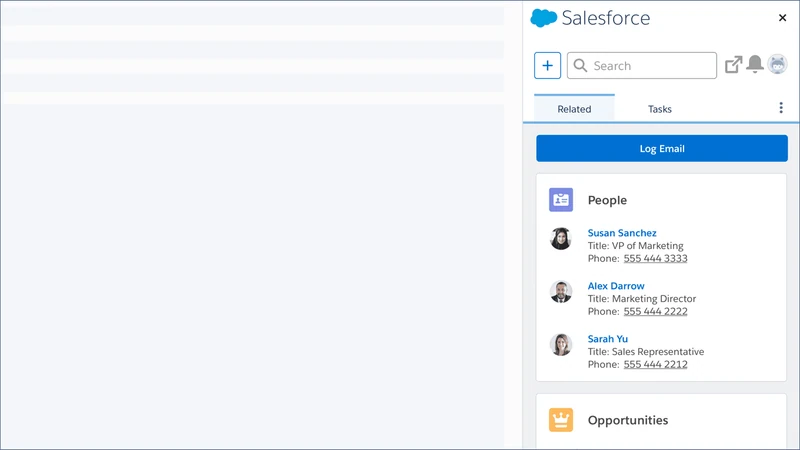
Salesforce Sales Cloud’s integration with Outlook was robust but required a significant setup effort. Once configured, the CRM allowed me to access and update records directly from my inbox. The live sync feature ensured that my emails and calendar events were accurately reflected in the CRM, which helped maintain consistency across all interactions.
However, I found that the platform’s extensive customization options could be both a blessing and a curse. While it allowed for tailored solutions, it also meant that navigating the system could be cumbersome without proper training. Despite its steep learning curve, Salesforce’s depth of features and enterprise-level capabilities made it a powerful tool for managing customer relationships.
Scoring
Features Salesforce Sales Cloud offers: 3/10
- Update and use your CRM from within your Outlook inbox
- Live sync your Outlook emails & Microsoft 365 calendar meetings to the CRM
- Use (shared or private) email templates when sending emails through the CRM
Features Salesforce Sales Cloud doesn’t offer:
- Auto-create contacts for people you’re emailing or meeting with
- Automatically enrich your contact database by syncing your contacts’ email signatures
- Send automated, personalized email sequences from your Outlook inbox
- See who your colleagues know and how well, with “relationship strength scores” based on their email traffic
- Track whether people open your emails and click on the links in your emails sent from Outlook
- See whether these people who clicked email links also visit your website, which pages and for how long
- Be reminded of emails you haven’t replied to or customer conversations that have gone quiet
Pros:
- Extremely customizable CRM built for enterprises (needs expert consultants)
- Both a web & COM add-in available for Outlook
Cons:
- Salesforce pricing is one of the highest in the market
- Not the most user friendly software
G2 review scoring:
- Ease of Use: 8.2
- Ease of Setup: 7.8
- Meets Requirements: 8.8
- Quality of Support: 8.1
- Ease of Doing Business With: 8.4
- Ease of Admin: 7.9
Final result
- Outlook CRM feature score: 3/10
- Average G2 review score: 8.2/10
- Google Play review score: 3.5/5 → 7.0/10
- FINAL SCORE: 6.1/10
Pricing
Pricing to get all of the above (3 of 10 features) on the Salesforce Sales Cloud Pro Suite plan:
$100/user/month (only billed annually)
Salesforce offers a free trial of 30 days.
Frequently asked questions
Is there a CRM for Outlook?
Yes. Salesflare is my top pick for small and medium-sized B2B teams that want automatic contact and activity capture and a full CRM inside Outlook. HubSpot suits teams combining sales, marketing and service; eWay-CRM suits an Outlook-for-Windows workflow; ActiveCampaign suits complex marketing automation. Other options mainly sync emails and calendars, so check the depth of inbox integration before choosing.
Does Microsoft 365 or Outlook have a CRM?
Outlook itself is not a sales CRM. Microsoft offers Dynamics 365 Sales separately, with an Outlook integration. Salesflare, HubSpot and ActiveCampaign also integrate closely with Outlook.
Can I use Microsoft 365 as a CRM?
Microsoft 365 offers a large range of business applications, but it doesn’t offer a CRM. It can however be used alongside many different quality CRMs. This allows you to manage your customer relationships in an integrated way.
What does CRM mean in Outlook?
In the context of Outlook, CRM usually refers to the integration of a CRM (Customer Relationship Management) system. CRM software like Salesflare provides native integration with Outlook to easily manage customer interaction and contacts seamlessly.
Is Microsoft Dynamics 365 a CRM?
Yes. Dynamics 365 is Microsoft’s business applications suite, and Dynamics 365 Sales is its sales CRM. It is worth considering for teams that need configurable sales processes in the Microsoft ecosystem.
Does Microsoft do a CRM?
Yes, Microsoft has a CRM solution known as Dynamics 365. It’s a part of the larger Dynamics 365 suite which also includes other business applications.
Want to dig deeper into the differences? Just ask our team using the chat on salesflare.com. We’re here to help 😄


I hope you liked this post. If you did, spread the word!
👉 You can follow @salesflare on Twitter, Facebook and LinkedIn.